
- Nvidia’s Rubin chip (2026) generates 2.3 kilowatts of heat per chip — nearly double its predecessor — and rack densities are scaling with it.
- Phoenix’s ambient heat load compounds the problem: a 120°F summer day narrows every thermal margin your cooling system depends on.
- Most cooling contractors are still quoting air-cooling rules of thumb against liquid-cooling bids. That gap bakes failure into your facility design before a single rack goes live.
- Vet for direct liquid cooling (DLC) commissioning experience, familiarity with ASHRAE TC 9.9 (the industry technical committee that publishes thermal guidelines for data center equipment), and references from AI or high-performance computing (HPC) deployments — not standard enterprise server rooms.
- This guide gives you the contractor qualification checklist and the questions to ask before density assumptions get locked into your design.
When Nvidia published thermal specifications for the Rubin chip in 2026, the number that caught facility managers’ attention wasn’t the performance headline — it was 2.3 kilowatts of heat per chip. A single 72-chip rack running Rubin GPUs can produce more than 160 kW of heat load. Per Data Center Knowledge, much of the existing raised-floor space in today’s data centers cannot physically support that density even when the square footage is available.
In Phoenix, that math gets harder. When your cooling infrastructure is fighting 115°F ambient air in August while managing 160 kW per rack, the difference between a contractor who has commissioned liquid cooling systems at AI densities and one who hasn’t isn’t a résumé gap — it’s an operational risk with real consequences on day one.
What 2.3 kW Per Chip Actually Means for Your Facility
- Air cooling stops being viable well before this density. Traditional computer room air conditioning (CRAC) and computer room air handler (CRAH) systems are typically designed for 5–20 kW per rack. At 100+ kW per rack, air-based systems can’t remove heat fast enough without cold-aisle containment, precision airflow engineering, and — in most cases — direct liquid cooling running in parallel or replacing air entirely.
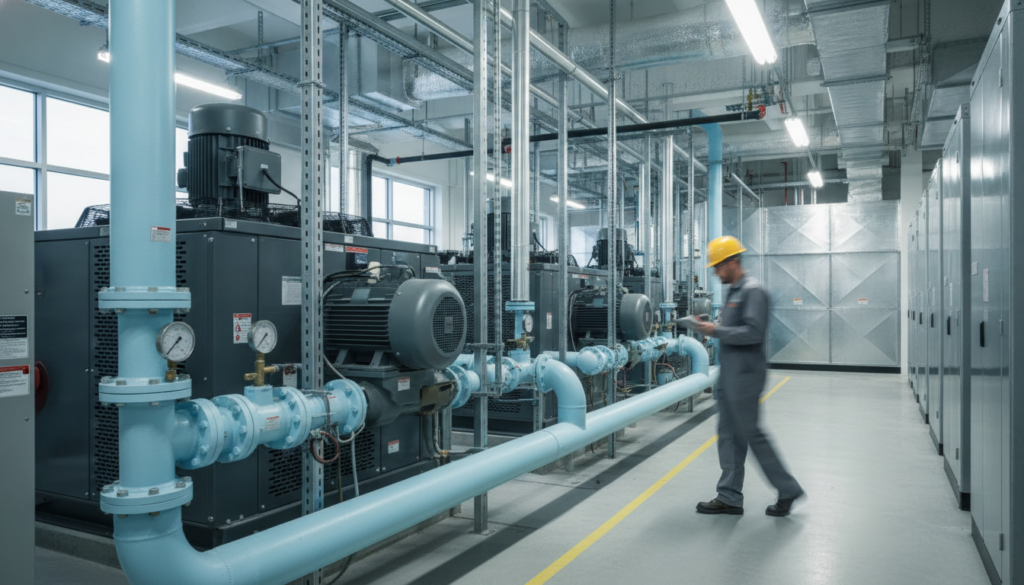
- Direct liquid cooling (DLC) is not a drop-in retrofit. Rear-door heat exchangers, cold plates, and immersion tanks each require different facility infrastructure: coolant distribution units (CDUs), leak detection loops, specialized piping, and commissioning procedures that differ substantially from mechanical/HVAC work on standard commercial buildings.
- Phoenix’s wet-bulb temperature limits your fluid-side heat rejection. Evaporative cooling towers — common in Phoenix because they work well in dry climates — approach their efficiency ceiling on peak summer days. A contractor who has engineered around Phoenix’s wet-bulb ceiling (which can reach 75–78°F in monsoon season) understands a constraint that out-of-state firms often miss in their initial designs.
- Density trends are not reversing. Rubin succeeded the Blackwell generation, which succeeded Hopper. Each step has increased per-chip thermal output. A cooling system designed for today’s density with no headroom is already behind schedule.
Bottom line: 2.3 kW per chip is not a niche AI problem — it’s the new design baseline for any Phoenix facility planning to host GPU workloads in the next 18 months.
The Phoenix Market: Why Local Conditions Raise the Stakes
Greater Phoenix has attracted significant data center investment — QTS, CyrusOne, EdgeConneX, and Iron Mountain all operate or are expanding facilities in the metro, concentrated in the Chandler, Mesa, and Goodyear corridors. That build velocity has tightened the mechanical contractor market: experienced firms are committed 12–18 months out, and the gap is being filled by contractors with commercial HVAC backgrounds pitching data center work.
Commercial HVAC and mission-critical mechanical are different disciplines. A contractor who excels at office building air handling may have never specified a CDU (coolant distribution unit), engineered a glycol loop for a data hall, or commissioned a system where a leak event triggers an emergency shutdown rather than a service call. The checklist they bring to your AI deployment will be the wrong checklist.
Arizona’s permitting environment adds a layer. Maricopa County mechanical permits for large commercial cooling systems require licensed contractors under the Arizona Registrar of Contractors (ROC) — and water use is subject to review given Arizona’s groundwater and Colorado River allocation constraints. Contractors unfamiliar with local water authority coordination can introduce weeks of permit delay on projects where your rack deployment timeline is already compressed.
Bottom line: Phoenix data center cooling is a specialty within a specialty. Local licensure, desert thermal engineering, and liquid cooling commissioning experience all need to be present in the same firm — or you’re assembling a team that’s never worked together on a live problem.
What Contractor Experience Actually Looks Like for High-Density AI Cooling
- Direct liquid cooling commissioning, not just familiarity. Ask whether they’ve commissioned a rear-door heat exchanger, cold plate, or immersion system — not just reviewed specs. References from completed deployments matter here.
- Thermal modeling before design freeze. Firms that have done high-density work typically run computational fluid dynamics (CFD) modeling or at minimum manual thermal calculations before finalizing cooling capacity. Contractors quoting capacity from rule-of-thumb multipliers are guessing.
- ASHRAE TC 9.9 literacy. ASHRAE TC 9.9 publishes the standard thermal envelopes and design guidance the industry uses for data center equipment. A contractor who can’t reference it in conversation hasn’t used it on a project.
- Arizona ROC license, mechanical classification. Verify the license is active and in the correct classification for the scope of work. The ROC license lookup is public at azroc.gov.
- Experience with Phoenix-specific heat rejection. This means designing around wet-bulb limits, sizing cooling towers or dry coolers appropriately for summer peak, and understanding how evaporative efficiency degrades during monsoon season.
- 24/7 emergency response capability. A cooling failure in a live AI compute facility is not a next-business-day problem. Confirm the contractor has on-call staffing and a documented response time — and that their subcontractors do too.
Bottom line: You’re not looking for the best commercial HVAC firm in Phoenix — you’re looking for a firm that has commissioned cooling at 100+ kW rack densities and knows what the Arizona desert does to their calculations.
10 Questions to Ask Before You Sign a Cooling Contract
- Can you provide your Arizona ROC license number for verification, and what classification covers the mechanical scope of this project?
- How many data center cooling projects have you commissioned in the past 24 months? What were the rack density ranges?
- Have you designed or commissioned a direct liquid cooling system — rear-door heat exchangers, cold plates, or immersion — on a completed project? Can you provide a reference contact?
- What thermal modeling approach do you use before finalizing cooling capacity? Do you run CFD analysis or use another validated method?
- How do you account for Phoenix’s wet-bulb temperature ceiling when sizing heat rejection equipment for peak summer conditions?
- Are you familiar with ASHRAE TC 9.9 thermal guidelines? Which envelope classes do you typically design to?
- What is your emergency response time for a cooling system failure in a live data hall? Is that covered under a service contract or billed separately?
- Have you coordinated mechanical permits with Maricopa County for large-scale cooling systems? Are you familiar with local water authority review requirements for evaporative systems?
- How do you handle future density headroom in your designs? What happens when rack density grows 30% after commissioning?
- What is your insurance coverage — specifically general liability limit and workers’ compensation — and can you provide a current certificate?
How datacenterups.com Vets Our Listings
- Arizona ROC license confirmed active — we verify the license classification and standing before a contractor is listed.
- Insurance certificate reviewed annually — minimum general liability and workers’ compensation coverage required.
- Data center project portfolio — at least one completed data center mechanical or cooling project, with a verifiable reference contact.
A listing in our directory is not a certification. We verify the baseline credentials. The technical interview — including the questions above — is your responsibility and is the only way to confirm that a contractor’s experience matches your specific density and facility requirements.
Browse Phoenix Cooling Contractors
Ready to find a cooling contractor who has actually worked at AI rack densities in Phoenix? Browse vetted mechanical and cooling contractors in the Phoenix metro →