
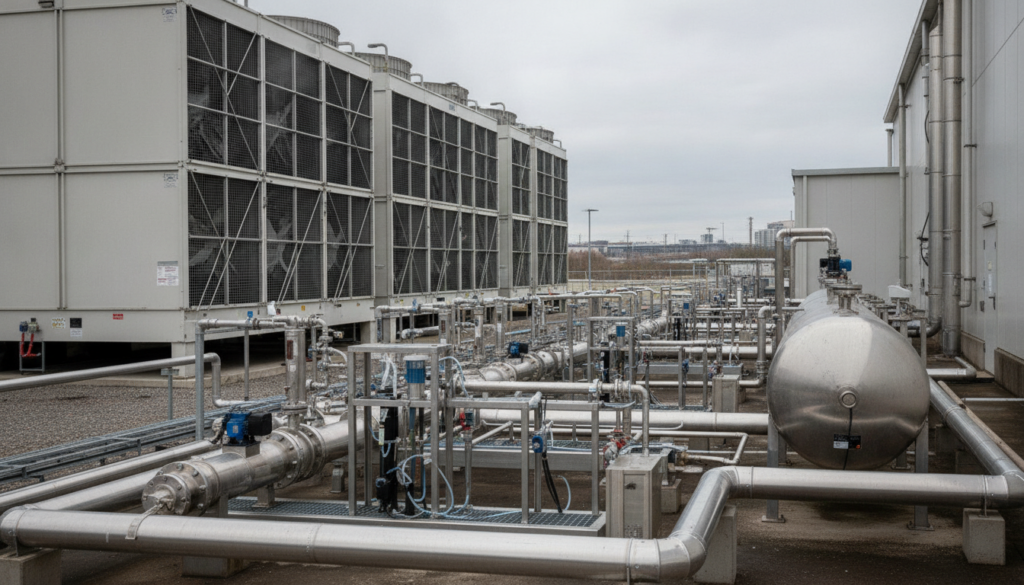
- A new HyperSolved water treatment system deployment from Gradiant for a West Texas data center (per DataCenter Dynamics) signals water platforms are being scoped as a distinct contract line, not folded into the cooling package.
- Cause: rising water-use disclosure pressure in Texas and other drought-sensitive states is pushing facility teams to treat water chemistry, reuse, and discharge as specialized work.
- Risk: assuming your mechanical/HVAC contractor has water treatment covered — many don’t hold this as a core specialty.
- Action: ask directly whether water treatment is being bid separately, and vet that scope with its own criteria before you sign.
A West Texas data center just contracted Gradiant, a water treatment technology company, to deliver its HyperSolved system as a standalone platform — not a subcomponent of the cooling installation, according to DataCenter Dynamics. That distinction matters more than it looks.
For years, water treatment on a data center build got bundled into the mechanical/HVAC scope by default. The chiller contractor handled the cooling loop, and water chemistry was an afterthought inside that same contract. Deals like this one suggest that’s changing.
Why Water Is Splitting Off From the Cooling Contract
- Water-use disclosure rules are spreading. States including Texas have seen growing legislative and utility pressure on data centers to report water consumption, particularly for evaporative cooling towers that use significant volumes per megawatt.
- Cooling technology has diversified. Direct-to-chip liquid cooling, adiabatic systems, and closed-loop designs each have different water chemistry, filtration, and reuse requirements — a single HVAC generalist may not carry expertise across all of them.
- Water treatment is a licensed specialty in its own right. Backflow prevention, chemical dosing systems, and wastewater discharge permitting often fall under separate state and local requirements than mechanical contracting licenses.
- West Texas water scarcity raises the stakes. In drought-prone regions, water reuse and treatment efficiency directly affect whether a facility can secure or keep its water allocation from local utilities.
Bottom line: Water treatment is shifting from an assumed inclusion to a scoped, separately contracted discipline — verify which one you’re getting before the RFP goes out.
What This Means for Dallas-Fort Worth Buyers
Dallas-Fort Worth sits in a water-stressed region with its own patchwork of municipal water restrictions and reuse incentives. Facility teams building or retrofitting cooling systems here face the same disclosure and scarcity pressure driving the West Texas deal.
If your mechanical/HVAC contractor’s proposal doesn’t mention water chemistry monitoring, treatment chemical management, or discharge compliance as a distinct line item, that’s a gap worth asking about directly — not assuming it’s covered.
Some cooling contractors partner with or subcontract to dedicated water treatment firms. Others build that expertise in-house. Either can work, but you need to know which one you’re getting before signing.
Bottom line: In a water-constrained metro like Dallas-Fort Worth, confirm water treatment scope explicitly rather than assuming your cooling contractor has it built in.
Questions to Ask Before You Assume It’s Covered
- Is water treatment a separate line item in your proposal, or bundled into the mechanical scope?
- Do you hold any state-specific water treatment or backflow prevention certifications, separate from your mechanical license?
- Who handles chemical dosing and water chemistry monitoring after installation — your team or a subcontractor?
- Have you worked with closed-loop or direct-to-chip liquid cooling systems, and do their water treatment needs differ from tower-based systems?
- How do you approach water reuse or greywater systems to reduce consumption reporting exposure?
- What is your process for discharge permitting with the local municipal water authority?
- If water treatment is subcontracted, who is that firm, and can I speak with a reference from a completed data center project?
- How do you handle water quality testing frequency once the system is operational?
- What happens if a water-use disclosure requirement changes mid-project — is that a change order or included in scope?
- Can you provide documentation of past work meeting local water utility compliance requirements in the Dallas-Fort Worth area?
How DataCenterUPS Vets Our Listings
- License status confirmed for the trade category listed, verified against state licensing boards where applicable.
- Insurance certificate verified — general liability and workers’ compensation coverage on file.
- Data center project history — contractors indicate relevant project experience, which we spot-check where possible.
Listing in our directory is not a certification of water treatment expertise specifically — that’s a specialized scope you should confirm directly with any contractor, mechanical or otherwise, using the questions above. Our vetting covers licensing and insurance basics; the scope-specific due diligence is yours.
Browse Dallas-Fort Worth Mechanical/HVAC Contractors
Ready to find a contractor who can speak clearly to water treatment scope? Browse vetted mechanical/HVAC contractors in Dallas-Fort Worth →